Progress Without Direction:
The modern world proudly claims to be the most advanced era in human history. Technology has reached extraordinary heights, information travels instantly, and societies boast unprecedented freedom of choice. Yet beneath this surface of progress lies a disturbing reality: humanity is more anxious, divided, and morally confused than ever before.
Wars continue despite global institutions. Inequality grows despite economic “development.” Families collapse despite social liberation. Mental health crises rise despite material comfort.
This contradiction forces an uncomfortable question:
If modern ideologies are so advanced, why does the modern world feel so broken?
To understand this crisis, we must examine the foundations upon which today’s global systems are built—and why they continue to fail humanity.
The Core Problem: Human-Centered Ideologies in a Complex World
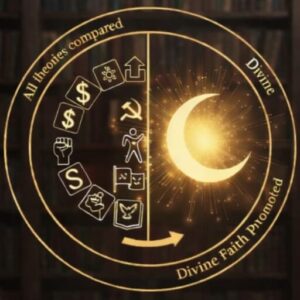
Modern ideologies—such as capitalism, socialism, liberalism, secularism, nationalism, and feminism—share one fundamental assumption: human beings can define morality, justice, and purpose without divine guidance.
These systems emerged largely after the rejection of religion from public life, especially following the Enlightenment.
The promise was simple and attractive: free humanity from God, tradition, and revelation, and human reason will create a better world.
But history has shown a painful truth—human reason alone is inconsistent, biased, and often driven by power, desire, and fear.
When humans become the ultimate lawmakers, morality changes with time, culture, and political interest. What is “right” today becomes “wrong” tomorrow. Justice becomes negotiable. Truth becomes relative.
Capitalism: Wealth Without Justice
Capitalism promised prosperity and innovation. While it succeeded in creating wealth, it failed to distribute it fairly.
Today, a small percentage of the global population controls the majority of the world’s resources, while billions struggle for basic necessities. Profit has become more valuable than human dignity. Corporations shape policies, exploit labor, and destroy environments—all in the name of economic growth.
Islam, by contrast, recognizes wealth as a trust, not an absolute right. It allows ownership but regulates it with moral responsibility, zakat, prohibition of exploitation, and social accountability—ensuring balance between individual effort and collective welfare.
Liberalism & Secularism: Freedom Without Meaning
Modern liberalism celebrates absolute personal freedom. But freedom without moral boundaries has produced confusion rather than fulfillment.
Family structures weaken. Identity becomes fluid and unstable. Individuals are told to “create their own meaning,” yet suffer from loneliness, depression, and existential anxiety.
Islam offers freedom—but not the freedom to self-destruct. It provides purpose-driven freedom, where human desires are guided, not suppressed, and life has clear meaning rooted in accountability to the Creator.
Socialism & Nationalism: Equality That Turned Into Oppression
Socialism promised equality but often delivered authoritarian control. Nationalism promised unity but fueled racism, war, and exclusion.
Both failed because they ignored human nature—greed, ego, and the desire for dominance. Systems that rely on “ideal humans” collapse when real humans take power.
Islam acknowledges human flaws and designs systems that limit abuse through divine law, accountability, and moral restraint—rather than blind trust in institutions or leaders.
The Moral Crisis: When Everything Becomes Relative
Perhaps the greatest failure of modern ideologies is moral relativism. When there is no absolute truth, everything becomes debatable—justice, gender, family, even the value of life.
This has led to a world where power defines truth, media shapes morality, and ethics change according to convenience.
Islam stands apart by grounding morality in divine revelation, not public opinion. Right and wrong are not voted into existence—they are discovered through guidance from the One who created humanity.
Islam: Not an Ideology, But a Complete Way of Life
Islam is often misunderstood as merely a religion confined to rituals. In reality, Islam presents a comprehensive framework addressing:
- Individual purpose
- Moral character
- Family structure
- Economic justice
- Social responsibility
- Governance and law
- Accountability in this life and the next
Unlike modern ideologies, Islam does not change with trends. Its principles remain stable while its applications remain flexible—allowing relevance across cultures and eras.
Islam does not promise a utopia without struggle. It promises guidance, balance, and justice—rooted in the understanding of human nature.
Why the World Still Needs Islam
The failure of modern ideologies is not accidental—it is structural. Systems built on limited human wisdom cannot solve problems created by human weakness.
Islam does not reject progress. It gives progress direction.
It does not reject freedom. It gives freedom purpose.
It does not reject diversity. It unites diversity under justice and accountability.
In a world exhausted by broken promises, Islam offers something rare: a coherent vision of life that connects the soul, society, and system into one moral framework.
Conclusion: Returning to Guidance, Not Backwardness
Turning to Islam is not a step backward into the past—it is a step forward toward clarity, balance, and meaning.
Humanity does not suffer from a lack of intelligence or resources. It suffers from a lack of guidance.
And history continues to show that when humans abandon divine guidance, they do not become free—they become lost.