
History records certain eras that symbolize not only political dominance but also the rise of civilization, knowledge, and justice. Among them, the Ottoman Empire stands as one of the most influential Islamic states in world history. For centuries, it represented not merely a political entity but also the symbolic leadership of the Muslim world through the institution of the Caliphate.
The Ottoman journey began in the late 13th century as a small principality. Over time, it expanded into a vast empire stretching across Asia, Europe, and Africa. Its early strength was built upon disciplined leadership, military organization, and adherence to Islamic principles of governance.
A defining moment came in 1453 when Constantinople was conquered, marking a major turning point in world history. This victory transformed the Ottomans into a dominant global power, controlling key trade routes between East and West and establishing themselves as a central force in international politics.
During the reign of Suleiman the Magnificent, the empire reached its golden age. Law, administration, architecture, education, and cultural development flourished. The Ottoman system allowed diverse religious and ethnic communities to coexist under a structured legal framework, maintaining relative stability across vast territories.
However, history shows that no civilization remains at its peak forever. The seeds of decline often begin to appear even during periods of strength. Subtle administrative weaknesses and emerging internal tensions gradually laid the foundation for future challenges.
The decline of great empires rarely happens due to external forces alone. Internal divisions often play an equally critical role. In the case of the Ottoman Empire, growing administrative corruption, political rivalries, and ideological differences weakened the central structure over time.
Part-2
Internal Divisions and the Arab Revolt: The Beginning of Fragmentation
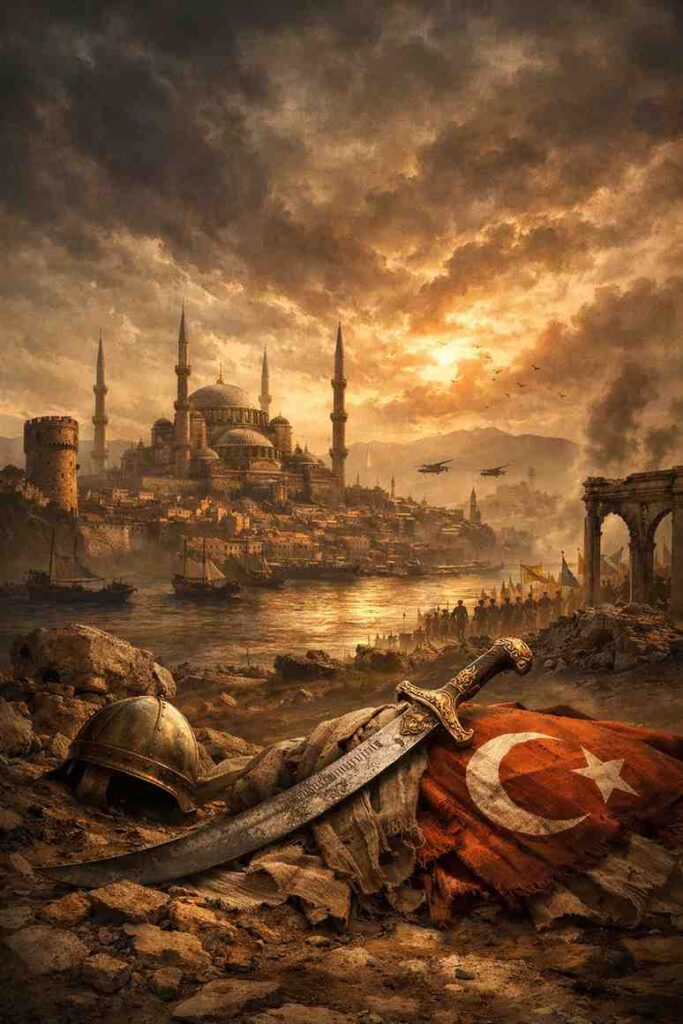
By the 19th century, Europe had undergone the Industrial Revolution, rapidly advancing in technology, military power, and economic strength. The Ottoman Empire, however, struggled to keep pace with these transformations. This gap widened the imbalance between the empire and European powers.
During World War I, a major turning point occurred in the Arab provinces. The Arab Revolt emerged when certain Arab leaders aligned with foreign powers against Ottoman rule. Promises of independence were made, though many were later unfulfilled. This revolt deeply affected the unity of the Muslim world and weakened the central authority of the empire.
At the same time, European powers were secretly planning the division of Ottoman territories. This geopolitical maneuvering further intensified internal instability and contributed to the fragmentation of the empire.
PART–3
From Sèvres to Lausanne: The Final Collapse of the Caliphate
The end of World War I marked a devastating phase for the Ottoman Empire. Defeated and weakened, the empire faced intense political pressure from the Allied Powers, who sought to divide its territories.
In 1920, the Treaty of Sèvres was imposed, aiming to partition large parts of Ottoman lands among European powers. This agreement significantly reduced Ottoman sovereignty and symbolized the near-collapse of imperial authority.
In response, a nationalist movement emerged under the leadership of Mustafa Kemal Atatürk. This movement rejected the terms of Sèvres and fought for national independence. As a result, the Treaty of Lausanne was signed in 1923, establishing the borders of modern Turkey and granting it international recognition as a sovereign nation-state.
This transition marked the end of the Ottoman imperial system and paved the way for a new political order based on nationalism and modern statehood. With this shift, the traditional Caliphate system began to lose its political relevance.
PART–4
The Abolition of the Caliphate and the Rise of Secularism: Lessons from History
In 1924, the Caliphate was officially abolished, marking the end of a centuries-old institution that had symbolized unity in the Muslim world. This was not merely a political change but a profound transformation in the ideological and social structure of the region.
Following the abolition, the new Turkish Republic adopted a secular framework. Religion was separated from state affairs, and nationalism became the foundation of governance. Significant reforms were introduced in law, education, and administration.
While these reforms contributed to modernization, industrial development, and administrative efficiency, they also sparked debates about cultural identity and religious values. Many argued that the rapid transition created a disconnect between traditional Islamic heritage and modern political systems.
History teaches that no civilization can sustain itself through power alone. Unity, justice, and moral foundations are essential for long-term stability. At the same time, knowledge, science, and governance are necessary for progress.
The Ottoman experience serves as a powerful lesson: internal division weakens nations, external influence accelerates decline, and ideological transformation reshapes civilizations.
In conclusion, the rise and fall of the Ottoman Caliphate is not merely a historical event—it is a reminder that civilizations survive only when they balance strength with unity, and progress with values.