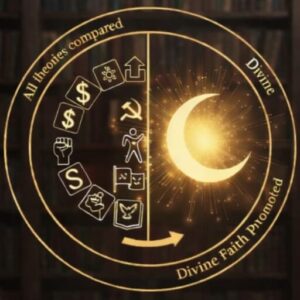
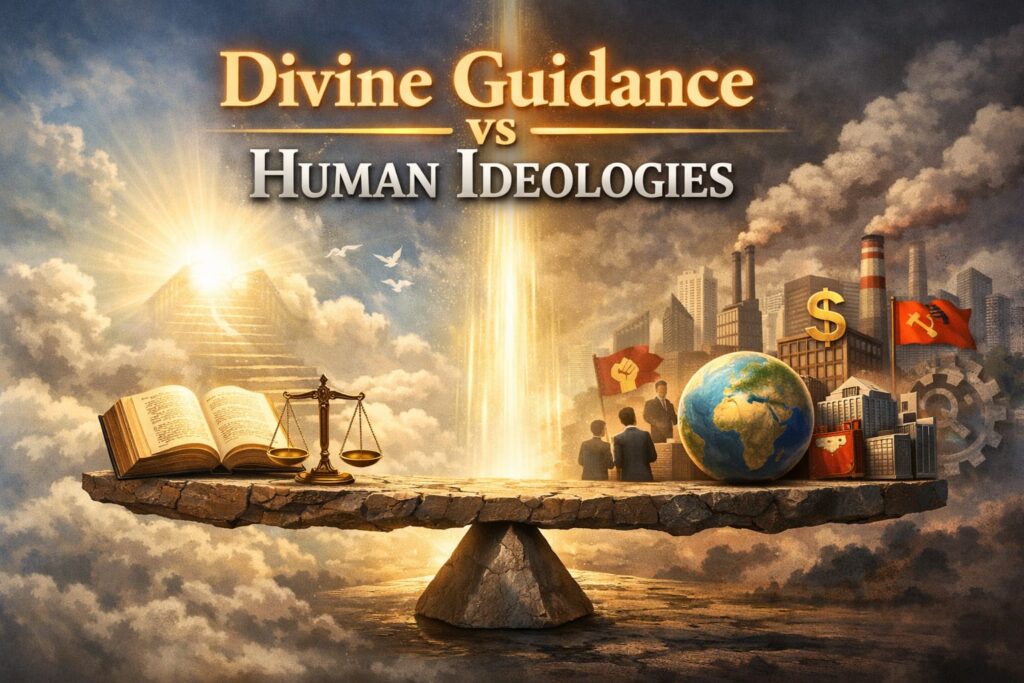
Human societies have always searched for principles that can organize life, establish justice, and give meaning to existence. Over time, this search produced various human ideologies—capitalism, socialism, nationalism, secularism—each shaped by specific historical conditions, intellectual movements, and material concerns.
Human ideologies are, emphasising, fundamentally reactive. They emerge in response to crises, inequalities, or failures of earlier systems. Capitalism arose to challenge feudal stagnation, socialism reacted to capitalist exploitation, and secularism developed as a response to religious authority being misused for power. While these systems addressed certain problems, they also generated new contradictions—economic disparity, authoritarian control, moral fragmentation, or identity conflicts.
Divine guidance represents a fundamentally different claim. Rather than emerging from historical reaction, it presents itself as a source beyond human limitations—offering principles intended to remain stable across time, culture, and political change. Its focus extends beyond economic efficiency or political order, addressing moral accountability, justice, purpose, and the ethical boundaries of power.
A key distinction lies in authority and scope. Human ideologies derive authority from human consensus, institutions, or force, making them vulnerable to manipulation and reinterpretation. Divine guidance, in contrast, claims moral authority independent of human interest, placing ethical limits on both rulers and societies.
History highlights this contrast clearly. Human ideologies continuously evolve, fracture, or collapse, requiring constant reform. Divine guidance, when sincerely followed, offers continuity—a moral framework not subject to shifting political or economic pressures.
The comparison, therefore, is not about rejecting human reason, but about recognizing its limits. The central question remains: can systems designed by human intellect alone provide lasting justice and inner stability, or does humanity require guidance grounded in something beyond itself?