
How the Industrial Revolution Reshaped Power, Inequality, and the World
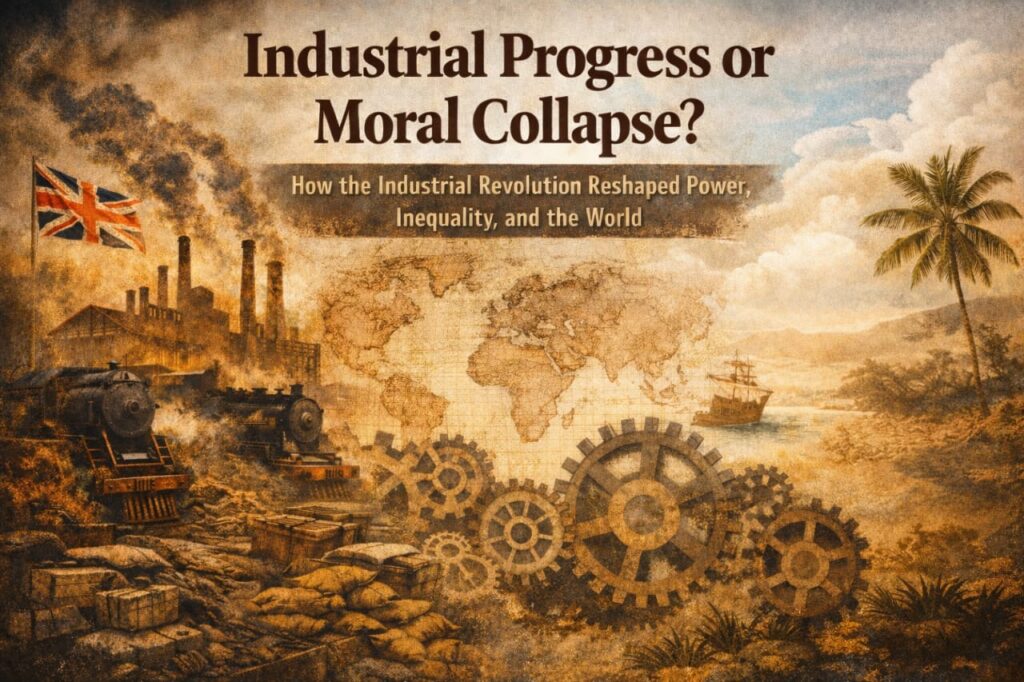
The modern global order—where a small group of nations enjoys prosperity while large parts of the world struggle with poverty, instability, and dependency—did not arise overnight. Its foundations were laid during one of history’s most transformative moments: the Industrial Revolution. While it is often celebrated for technological progress and economic growth, the Industrial Revolution also triggered a darker transformation—one that reshaped power relations across the world and gave imperialism a structural foundation.
Before industrialization, economies were primarily agrarian and localized. Societies produced largely for their own consumption, and international trade played a limited role. This balance changed dramatically in the late eighteenth century when mechanized production, factories, and steam power revolutionized manufacturing in Europe. Production increased at an unprecedented rate, creating a new and urgent problem: domestic markets could no longer absorb the massive surplus of goods.
To survive, industrial economies needed new markets—and fast.
This economic pressure pushed industrial powers such as Britain, France, and later Germany toward expansion beyond their borders. Asia, Africa, and Latin America became the targets of this expansion, not merely for political dominance but for economic survival. Colonies provided three essential pillars for industrial capitalism: cheap raw materials, captive markets for finished goods, and abundant low-cost labor. In this sense, imperialism was not simply a moral failure—it was an outcome built into the logic of industrial production.
History offers sobering examples. India, once a global center of textile production, saw its indigenous industries deliberately destroyed under British rule to make room for British factory-made goods. Similar processes unfolded across Africa, where colonial economies were designed around the extraction of a few resources rather than the development of self-sustaining industries. Even after political independence, many of these countries remained locked into unequal economic structures that continue to shape their realities today.
Although formal colonial rule has largely ended, imperialism itself has not disappeared. It has evolved. In the contemporary world, power is exercised through international financial institutions, multinational corporations, technological monopolies, and unequal trade agreements. Many developing nations remain dependent on external capital, technology, and markets—echoing the same patterns established during the industrial age.
This raises a critical question: was imperialism inevitable without the Industrial Revolution? History suggests that domination and expansion existed before industrialization, but never on such a global, systematic, and deeply entrenched scale. The Industrial Revolution transformed imperialism into a highly efficient and profitable system—one capable of reshaping the entire world economy.
At this point, a deeper question emerges: is this global inequality simply an unfortunate outcome of progress, or does it reflect a deeper moral failure in human-made systems?
From an Islamic perspective, the problem lies not in technology or productivity itself, but in the values governing their use. Islam rejects economic systems built on exploitation, unchecked accumulation, and the suffering of others. Instead, it emphasizes justice (`adl), balance (mizan), accountability, and the ethical distribution of wealth. Concepts such as the prohibition of exploitation, the obligation of social responsibility, and the recognition that resources are a trust from God directly challenge the foundations of imperial and neo-imperial systems.
Islam offers an alternative vision—one where economic activity serves human dignity rather than dominating it, where power is restrained by moral accountability, and where prosperity is not achieved at the expense of others. In a world still shaped by the legacy of the Industrial Revolution and its inequalities, Islamic guidance provides not just criticism, but a framework for justice-driven solutions.
Understanding this history is essential—not to remain trapped in the past, but to make conscious choices about the future. Progress without ethics leads to domination. Power without moral restraint leads to injustice. Islam reminds humanity that true advancement is not measured by production alone, but by justice, responsibility, and compassion.