In today’s digital world, we are not suffering from lack of information—we are overwhelmed by too much information. Every day, we scroll through countless videos, posts, news, and opinions on social media. Many of these contents go “viral” within a very short time and reach millions of people.
But an important question is: Are these contents really informing us, or are they shaping how we think? Are we following the truth, or are we living inside a reality that is carefully created for us?
Viral Content: Influence Behind Popularity
Viral content is not always neutral. It is often designed to quickly grab attention and trigger emotions like happiness, anger, fear, or sadness.
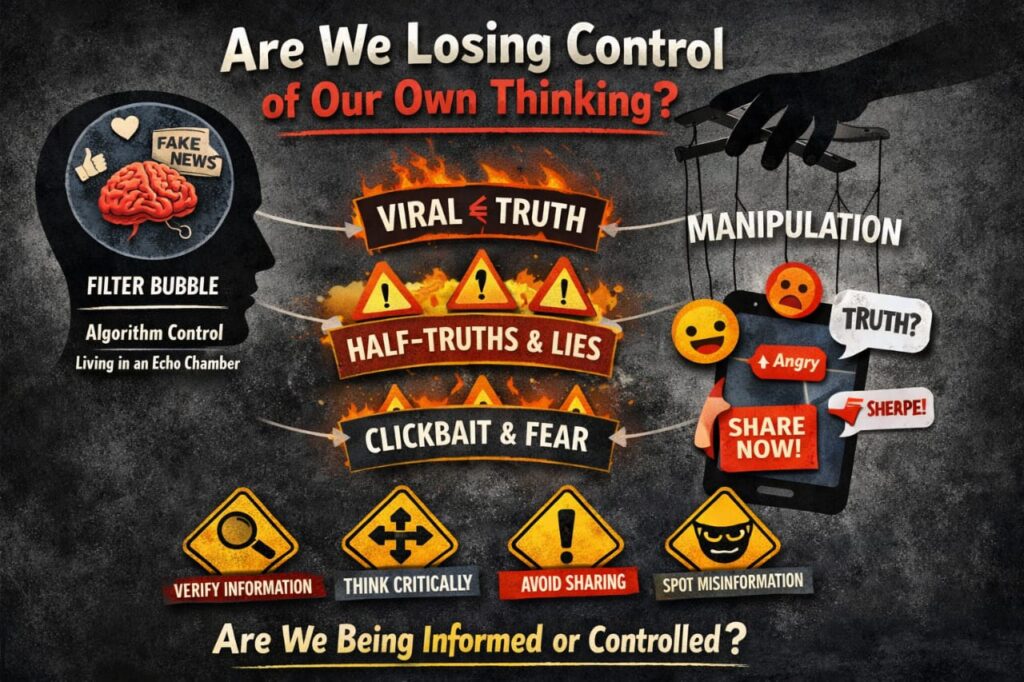
Today, what matters more is not “how true” something is, but “how viral” it becomes. Because of this, the quality of information becomes less important than its impact.
This creates a dangerous situation where popularity starts replacing truth.
The Hidden Power of Algorithms
Social media platforms use algorithms to understand what we like, what we watch, and what we share. Based on that, they show us more similar content.
As a result, we get stuck in a “filter bubble” where we mostly see things that match our beliefs. We rarely see different opinions or the full picture.
We think we are choosing what to see, but in reality, much of it is being chosen for us.
Emotion Over Logic: Are We Becoming Reactive?
Viral content is powerful because it directly affects our emotions.
A single video can make us cry, feel angry, or get excited within seconds. But this emotional reaction often weakens our logical thinking.
We stop analyzing—we start reacting.
We stop verifying—we start sharing.
Over time, this can turn society into a reactive one, where emotions become stronger than reasoning.
Truth, Half-Truth, and Misinformation
A large portion of viral content is not fully true. It can be misleading, taken out of context, or even completely false.
Such content can:
Create confusion in society
Increase mistrust among people
Lead to social or political problems
The most worrying part is that people often believe and share this information without checking it.
Islamic Perspective: The Responsibility to Verify
In Islam, verifying information is very important. The Qur’an teaches us that when we receive news, we should check it before accepting or spreading it.
This reminds us that sharing unverified information is not just an intellectual mistake, but also a moral responsibility.
In today’s world of social media, this teaching is more relevant than ever.
Where Do We Stand Today?
Today, we are living in a time where information is not only influencing us—it is shaping how we think and sometimes even controlling us.
Our opinions, choices, and beliefs are slowly being affected by the content we consume every day.
The question is: Are we aware of this influence?
Solution: Awareness and Responsibility
To deal with this situation, we need to be more conscious and responsible.
Verify information before believing it
Look at different sources and opinions
Think critically instead of reacting emotionally
Avoid sharing unverified content
Most importantly, we must understand that we are not just consumers of content—we are also spreaders of information.
Social media viral content is not always reality—it is often a version of reality that is created and presented to us.
If we accept it blindly, we may lose control over our own thinking. But if we stay aware, question things, and verify information, we can protect ourselves from being misled.
In the end, one question remains: Are we using information, or is information using us?