In today’s world, “human rights” is one of the most powerful and respected phrases. Governments speak about it. International organizations defend it. Activists protest in its name. From freedom of speech to the right to life, human rights are presented as universal, equal, and unquestionable.
But a serious philosophical question remains: If there is no higher authority above human beings, on what foundation do human rights truly stand?
This is not a question of emotion. It is a question of foundation.
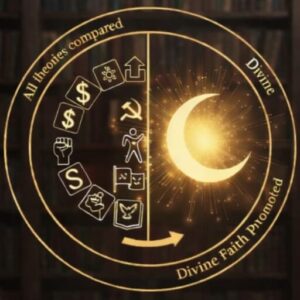
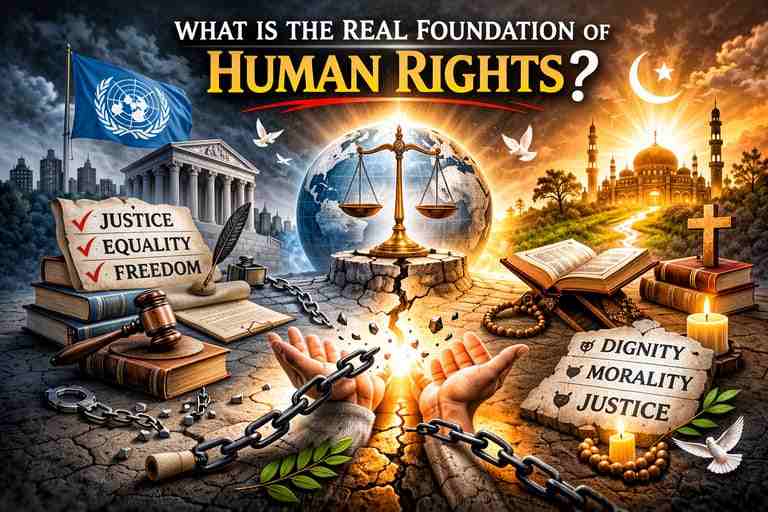
Modern human rights theory is largely built on secular thinking. It argues that rights come from human dignity, social contracts, or collective agreement. In this framework, rights are defined and protected by constitutions, courts, and international law. In other words, humans define rights for humans.
At first glance, this seems reasonable. But it creates a deep tension. If rights are defined by human agreement, then they can also be changed by human agreement. What a parliament gives, another parliament can remove. What one generation considers a right, another generation may reject.
History shows this clearly. Slavery was once legal. Colonialism was once justified. Discrimination was once normal. All were defended by human laws at the time. If society defines morality, then morality shifts with society.
This raises a difficult question:
If rights are not rooted in something permanent and above human power, are they truly universal—or simply political decisions?
A purely secular system often says that rights come from “human dignity.” But where does this dignity come from? Why does every human life have equal value? Why is a weak child equal to a powerful leader? Why is injustice wrong, even if a majority supports it?
Without a higher moral source, equality becomes an opinion, not an absolute truth.
This is where belief in God changes the discussion.
If human beings are created by a Creator, then their dignity is not granted by the state. It is inherent. It is not voted into existence. It cannot be cancelled by a majority. Life, justice, and moral limits become sacred, not political.
In a God-centered worldview, rights are not invented—they are recognized. The role of law is not to create morality from nothing, but to protect what is already morally binding.
Critics argue that religion can also be misused. That is true. Throughout history, both religious and secular systems have been abused by those in power. The problem is not only belief or unbelief—it is human weakness. However, the philosophical difference remains important:
In a secular framework, morality ultimately depends on human consensus.
In a God-centered framework, morality is anchored in a higher authority beyond human desire.
This difference affects how stable rights truly are.
If society changes its mind tomorrow, can it redefine family, justice, life, or freedom completely? In a purely human-centered system, the answer is yes. In a God-centered system, there are moral boundaries that cannot be crossed, no matter how popular a decision becomes.
Asia, in particular, understands the importance of moral roots. Many Asian cultures, whether Muslim, Christian, Hindu, or others, do not see morality as something created by government alone. They see it as connected to divine law, spiritual tradition, and inherited wisdom.
That does not mean there is no debate. There is always debate. But it means morality is not floating without anchor.
The real issue is not whether human rights are good. Almost everyone agrees they are necessary. The real issue is this: Can human rights remain truly universal and stable if they are detached from any divine foundation?
If rights are based only on human power, they remain vulnerable to human power.
If rights are rooted in a higher moral authority, they stand above political change.
This debate will continue. But one thing is clear:
A society that wants strong and lasting human rights must ask not only what rights are, but where they come from.
Without a solid foundation, even the most beautiful structure can slowly crack.
And that is a question worth thinking about.