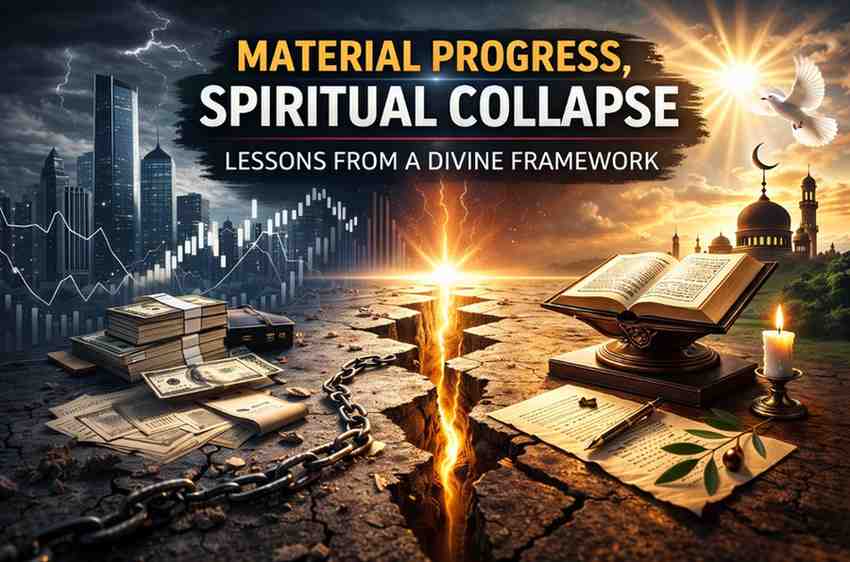
We live in an age of extraordinary material progress. Cities are taller, technology is smarter, and communication is faster than ever before. Artificial intelligence, advanced medicine, and global trade have transformed human life. Many nations measure success through GDP, industrial growth, and technological innovation.
But at the same time, another reality is visible. Anxiety, loneliness, depression, family breakdown, and moral confusion are rising across the world. Despite comfort and convenience, many people feel empty inside. The question naturally arises:
Has material progress come with a spiritual cost?
Modern society often assumes that economic development automatically leads to human happiness. If people have money, freedom, and entertainment, they will be satisfied. Yet statistics on mental health and social instability suggest a different story. Wealth has increased, but inner peace has not increased at the same speed.
Islam offers a different framework to understand this imbalance.
In Islam, human beings are not only physical creatures; they are spiritual beings with a soul (ruh). The Qur’an teaches that true peace comes from remembering and connecting with the Creator. Material comfort is allowed and even encouraged, but it is never the ultimate goal. The ultimate goal is balance — success in this world and success in the hereafter.
When material success becomes the only definition of progress, several problems appear.
First, morality becomes relative. If profit is the highest value, then ethical limits become flexible. Interest-based exploitation, corruption, consumerism, and injustice can easily be justified in the name of economic growth.
Second, family structure weakens. Islam places strong emphasis on family as the foundation of society. Marriage is not only a contract but a sacred responsibility. When individual desire becomes supreme and commitment becomes secondary, families become fragile.
Third, identity becomes confused. Without spiritual guidance, people search for meaning in trends, fame, or temporary pleasures. Social media recognition replaces real inner worth. Comparison replaces contentment.
Islam does not reject material progress. Historically, Muslim civilization produced scientists, scholars, architects, and traders who contributed greatly to global development. From the intellectual achievements of classical scholars to advances in medicine and mathematics, progress was encouraged — but always within moral boundaries.
The difference was not in technology, but in purpose.
Islam teaches that wealth is a trust (amanah), not an absolute possession. Power is a responsibility, not a privilege. Knowledge is meant to serve humanity, not dominate it. This moral framework protects society from spiritual collapse.
When spirituality weakens, material progress can turn destructive. Technology can be used for surveillance and manipulation. Wealth can deepen inequality. Freedom can turn into moral chaos.
The lesson from Islam is not to abandon development, but to anchor it in faith and ethics. A society that grows economically but forgets its moral compass risks losing its humanity.
True progress is not measured only by skyscrapers and stock markets. It is measured by justice, compassion, strong families, and inner peace.
Material growth without spiritual guidance creates imbalance.
Spiritual strength without responsible action creates stagnation.
Islam calls for harmony between the two.
In a world proud of its machines but uncertain about its meaning, this balance may be the lesson modern civilization needs most.