
Poverty remains one of the most painful realities of our modern world. Despite technological advancement, global wealth growth, and countless humanitarian campaigns, millions still struggle to secure their basic needs. Every year, billions are donated in charity across the globe. Yet poverty persists. This contradiction forces us to reflect: Is charity alone enough? Or are we overlooking a more effective and structured solution?
Charity, by its nature, is voluntary and emotional. It rises during crises and fades when attention shifts elsewhere. After natural disasters, wars, or humanitarian emergencies, donations pour in. But when headlines disappear, so does much of the support. Charity often addresses immediate suffering — food for the hungry, blankets for the cold, medicine for the sick. While this relief is undeniably valuable, it rarely transforms lives in a lasting way.
Moreover, charity lacks a universal system of accountability. Distribution can be uneven. Some individuals receive repeated assistance, while others remain unseen. In certain cases, long-term dependency develops instead of empowerment. The intention behind charity is noble, but good intentions alone cannot build sustainable economic justice.
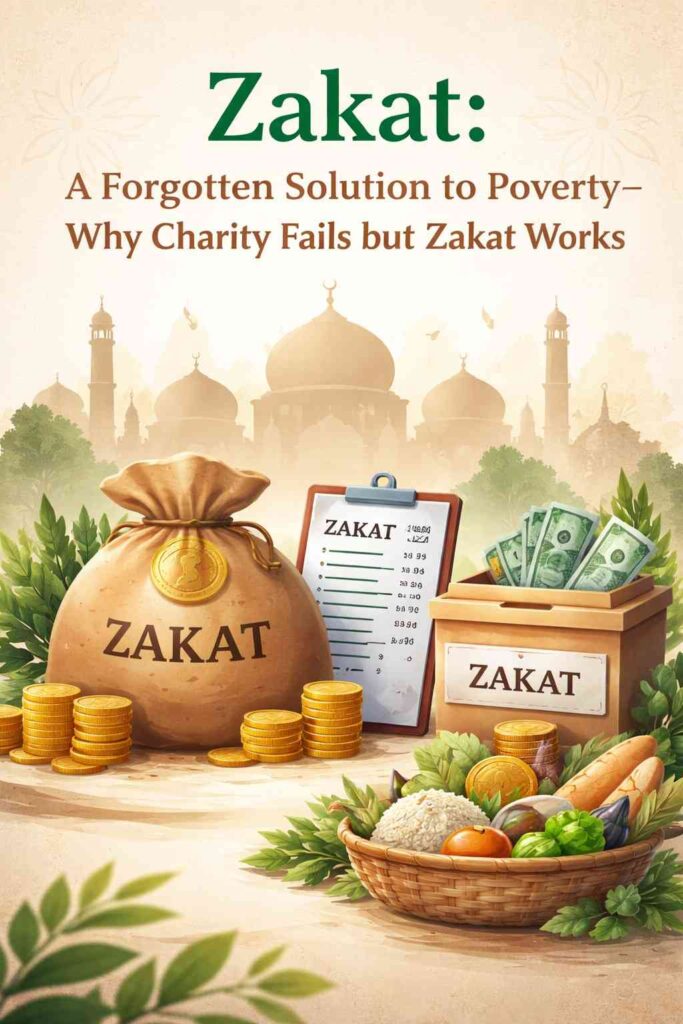
In contrast, the Islamic institution of Zakat offers a structured and systemic response to poverty. Zakat is not optional generosity; it is a mandatory obligation upon financially able Muslims. Each year, a fixed portion — typically 2.5% of accumulated wealth — must be distributed to specific categories of beneficiaries. This transforms wealth-sharing from an emotional act into a social responsibility.
What distinguishes Zakat from ordinary charity is its foundation in justice rather than sympathy. It recognizes that within wealth lies a right of the poor. This principle shifts the narrative. The disadvantaged are not passive recipients of kindness; they are rightful stakeholders in society’s economic resources.
Zakat also ensures continuity. Because it is obligatory and calculated annually, it creates a steady and predictable flow of funds. Such consistency allows for long-term planning — investment in education, healthcare, debt relief, and income-generating opportunities. Properly managed, Zakat can move beyond relief to empowerment.
Historically, there have been periods in Muslim civilizations when Zakat distribution was so effective that poverty significantly declined. While modern contexts differ, the principle remains powerful: systematic wealth redistribution reduces inequality and strengthens social cohesion.
At a time when global inequality widens and charitable giving struggles to create lasting change, it may be necessary to revisit structured models of social finance. Zakat represents more than a religious ritual; it embodies an economic philosophy grounded in responsibility, balance, and dignity.
The world does not suffer from a shortage of wealth. It suffers from imbalance. Charity soothes the symptoms. Zakat, when properly implemented, addresses the structure.
Perhaps the solution to poverty has not been absent — only forgotten.